Monday, June 4, 2007

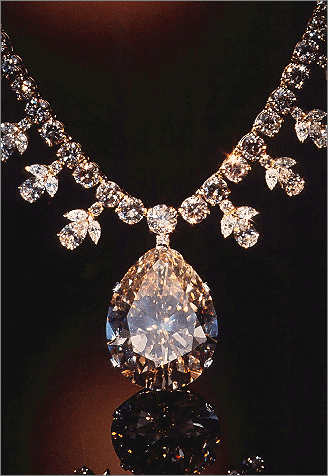
Victoria Transvaal Diamond

The Victoria-Transvaal is a 67.89-carat, brownish-yellow pear shaped stone. It was cut from a 240-carat crystal that was found in the Transvaal, South Africa. The first cutting produced a 75-carat 116-facet stone that measured 1 x 1³/8 inches; a recutting retained the same length and width, but reduced the depth to better proportions, making it more brilliant. The diamond has been featured in several Hollywood films, including a Tarzan episode from 1952 titled Tarzan's Savage Fury, and in leading exhibitions in the United States and Canada.

The necklace was designed by Baumgold Brothers, Inc, and consists of a yellow gold chain with 66 round brilliant-cut diamonds, fringed with ten drop motifs, each set with two marquise-cut diamonds, a pear-shaped diamond, and a small round brilliant-cut diamond (the total weight of the 106 diamonds is about 45 carats). The configuration of these stones makes them look like small angels! The necklace was donated by Leonard and Victoria Wilkinson in 1977 to the Smithsonian Institute, Washington D.C.

Other colored diamonds in the Smithsonian Collection include the 8.30-carat Shepard Diamond. This stone is from South Africa, and was acquired by the Smithsonian Museum in exchange for a collection of small diamonds that had been seized as smuggled goods by the United States Customs Service. The diamond is named for the Smithsonian employee who helped facilitate the transaction.

An extremely rare red diamond resides at the Smithsonian as well. This is the De Young Red, a 5.03-carat, brilliant cut red diamond. The main kite-shaped facets on the crown are divided in two, giving the stone more brilliance than a standard round brilliant cut. The stone is not pure red but has a slight brown hue, which makes it appear like a fine red garnet and indeed, it was once purchased as such at an estate sale.

It is the third largest red diamond in the world, after the Moussaieff Red (5.11 carats) and the Red Diamond (5.05 carats).

Read More...

Sunday, June 3, 2007

Hooker emerald


There’s something incredibly mysterious about the largest emeralds. It’s one of the rarest of gemstones, unattainable for most of us, at least in a good-quality stone. This magnificent 75.57-carat emerald was supposedly owned by the Ottoman Empire until 1900. Legend has it was used in the belt buckle of a sultan!

The stone was featured in Tiffany's 1950 Christmas Catalog. Mrs. Janet Annenberg Hooker bought the stone in 1955 from Tiffany's and donated it to the museum in 1977.

Emeralds are part of the beryl family of jewels. Green beryls are called emeralds, while blue-green beryls are called aquamarines. A pink shade of beryl is called Morganite. There’s even a red beryl that’s rarer than emeralds themselves.

The name emerald comes from the Greek smaragdos via the Old French esmeralde, and really just means 'green gemstone'. Innumerable fantastic stories have grown up around this magnificent gem. The Incas and Aztecs of South America, where the best emeralds are still found today, regarded the emerald as a holy gemstone. However, probably the oldest known finds were once made near the Red Sea in Egypt. Having said that, these gemstone mines, already exploited by Egyptian pharaohs between 3000 and 1500 B.C. and later referred to as 'Cleopatra's Mines', had already been exhausted by the time they were rediscovered in the early 19th century.

But it has also, for centuries, been the color of beauty and of constant love. In ancient Rome, green was the color of Venus, the goddess of beauty and love. And today, this color still occupies a special position in many cultures and religions. Green, for example, is the holy color of Islam. Many of the states of the Arab League have green in their flags as a symbol of the unity of their faith. Yet this color has a high status in the Catholic Church too, where green is regarded as the most natural and the most elemental of the liturgical colors.

Read More...